

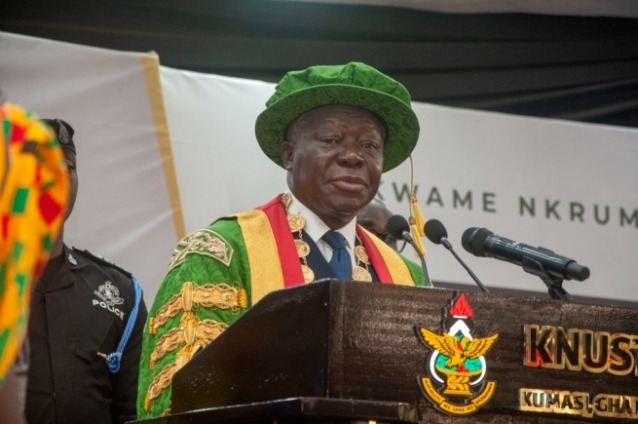
The long-delayed university hospital project at the Kwame Nkrumah University of Science and Technology (KNUST) has returned to the spotlight, as the Asantehene, Otumfuo Osei Tutu II, renewed calls for its completion following fresh budgetary approval by Parliament.
Addressing the 59th Special Congregation of the university in Kumasi, the revered traditional leader struck a tone that blended appreciation with urgency.
He acknowledged Parliament’s decision to approve funding for the project and commended the government for what he described as a critical step toward reviving a facility that has remained stalled for years.
The KNUST Teaching Hospital project, conceived as a flagship medical and academic facility, has long been viewed as central to the university’s ambition to deepen its contribution to healthcare delivery and medical education in Ghana.
However, like several major public infrastructure projects, it has faced delays largely attributed to funding constraints and implementation setbacks.
Otumfuo noted that the renewed financial commitment offers an opportunity not only to resume work but to restore confidence in the project’s eventual completion.
He emphasized that the hospital is not merely an institutional asset for KNUST, but a national investment expected to strengthen healthcare systems and expand access to quality medical services.
“When completed, this facility will serve as a hub for advanced medical training and research, while also providing critical healthcare services to surrounding communities,” he said, underscoring its dual role in education and public health.
The Asantehene’s remarks also reflected growing public concern over delays in key state-backed projects. He urged authorities to adhere strictly to the revised timeline, stressing that prolonged setbacks undermine both public trust and the intended socio-economic benefits of such investments.
He expressed optimism that with the budget now secured, the first phase of the hospital could be completed and commissioned before the end of the year—an expectation he personally directed at the Presidency.
“I will be waiting on the President to commission the first phase of the project by the close of the year,” he stated, signaling both confidence and accountability.
The renewed push for the hospital’s completion comes at a time when the tertiary institutions are increasingly seeking to integrate practical training with real-world service delivery. For KNUST, one of the country’s premier science and technology universities, the hospital represents a critical missing link in bridging academic excellence with hands-on medical practice.
If completed on schedule, the facility is expected to significantly reduce pressure on existing hospitals in Kumasi and the Ashanti Region, while positioning KNUST as a leading center for medical innovation and specialist care in West Africa.
About the Author