
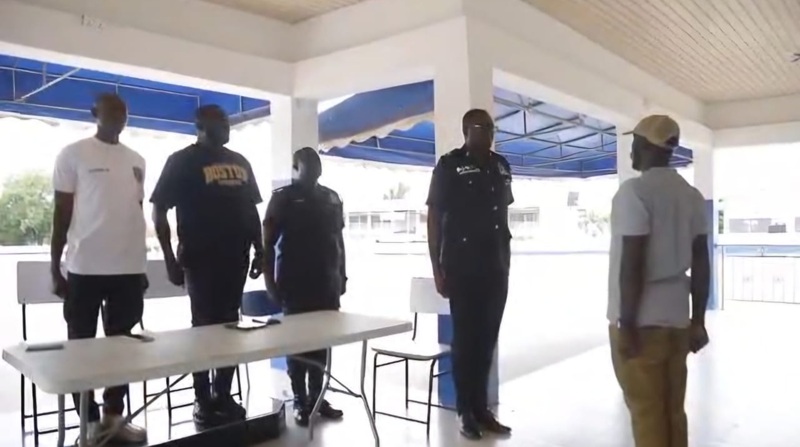
A major shake-up has hit the Inspector-General of Police’s Special Operations Team, popularly known as the “Black Maria,” following the removal of its commander, DSP Bawah Abdul Jalil, amid growing controversies surrounding his conduct during high-profile operations in the Northern Region.
The leadership transition, formalized at a handing-over ceremony on April 7, 2026, at the National Police Training School in Accra, saw DSP Bawah relinquish command to Superintendent Augustine Dawson Amoah, who now takes over the elite unit with the support of three senior officers.
While the police administration has not officially described the change as a dismissal, the timing of the move—coming on the heels of mounting public debate, political tension, and an ongoing assault investigation—has fueled widespread perception that the decision is directly linked to controversies surrounding DSP Bawah’s tenure in Tamale.
Deployment To Tackle Rising Crime
Bawah rose to national prominence in late 2025 when the Ghana Police Service deployed him to lead a special taskforce to the Northern Region following escalating security concerns.
Tamale, in particular, had witnessed a surge in armed robbery, drug trafficking—especially involving tramadol—and attacks on traders and mobile money vendors.
Under his leadership, the Special Operations Team embarked on aggressive intelligence-led operations targeting suspected drug dens, criminal hideouts, and transport networks used in illicit trade.
These operations led to multiple arrests and seizures, and significantly reduced the visibility of open drug peddling in parts of the metropolis.
The team’s assertive style earned it the nickname “Black Maria,” and quickly drew praise from sections of the public, especially youth groups in Dagbon who credited the unit with restoring a sense of safety and discipline.
Public Praise And Growing Political Undercurrents
Support for DSP Bawah’s operations was particularly strong among community-based groups such as the Dagbamba Youth Association, which openly commended the team for confronting drug abuse and criminality that had long plagued the region.
Residents reported that areas previously known for open drug trade became less active, while parents and traders expressed relief over improved security conditions.
However, the same operations also began to generate unease in some quarters, with allegations emerging that the team’s methods were overly forceful and, in some cases, politically sensitive.
Tensions escalated further when reports surfaced that some political actors had allegedly petitioned the police administration to withdraw DSP Abdul Jalil and his team, claiming that their operations were making the government unpopular in the region.
Haruna Institute Steps In
Amid the growing controversy, the Haruna Institute entered the fray, issuing a strongly worded statement to defend Haruna Iddrisu, the Member of Parliament for Tamale South and Minister of Education, who had been linked in some quarters to the alleged calls for the withdrawal of the taskforce.
The Institute, through its Chief Executive Officer Abdul-Ganiyu Sandow, categorically denied any involvement of the MP in influencing police decisions, describing the claims as “false, malicious, and orchestrated.”
The statement emphasized that Haruna Iddrisu holds no authority within the police hierarchy and cannot direct or interfere in operational decisions of the Inspector-General of Police.
The intervention by the Institute highlighted the increasingly political dimension of what had initially been a security operation, deepening public debate over the independence of law enforcement and the influence of political actors.
The Ibrahim Mahama Incident
The controversy surrounding DSP Bawah’s leadership reached a critical point following an incident on March 21, 2026, during Eid-ul-Fitr celebrations in Tamale, involving acclaimed Ghanaian artist Ibrahim Mahama.
Mahama alleged that he and his uncle were assaulted by police officers in an encounter near the Mariam Hotel junction.
The claims triggered national outrage and calls for accountability, given the prominence of the artist and the seriousness of the allegations.
In response, the Special Operations Team, under DSP Bawah, issued a detailed report denying any involvement in an assault on Mahama, instead describing the incident as a traffic enforcement operation involving a non-compliant commercial driver.
The conflicting accounts intensified scrutiny on the unit, raising broader questions about police conduct, use of force, and transparency in operations.
Subsequently, the Ghana Police Service launched a full-scale investigation into the alleged assault, with the Inspector-General of Police directing both criminal and professional misconduct probes.
Ibrahim Mahama, after meeting the Police Management Board, insisted that his pursuit of the case was not about compensation but about justice and accountability, further keeping the issue in the public spotlight.
Public Reaction And Protests
The combination of the alleged assault, political accusations, and reports of a possible recall of the taskforce sparked protests and public demonstrations in Tamale.
Some residents openly opposed any move to remove DSP Bawah, arguing that his leadership had brought order and discipline to the region.
Others, however, called for greater oversight of the team’s operations, insisting that security interventions must not come at the expense of citizens’ rights.
The situation underscored a deep divide in public opinion—between those who viewed DSP Bawah as a firm crime-fighter and those who believed his methods required closer scrutiny.
The Exit And New Leadership
It is against this complex backdrop that DSP Abdul Jalil has now been replaced, with Superintendent Augustine Dawson Amoah taking over command of the Special Operations Team.
At the handing-over ceremony, DSP Bawah urged officers to support the new leadership, while Superintendent Dawson Amoah pledged to uphold discipline, professionalism, and unity in continuing the team’s mandate.
About the Author