
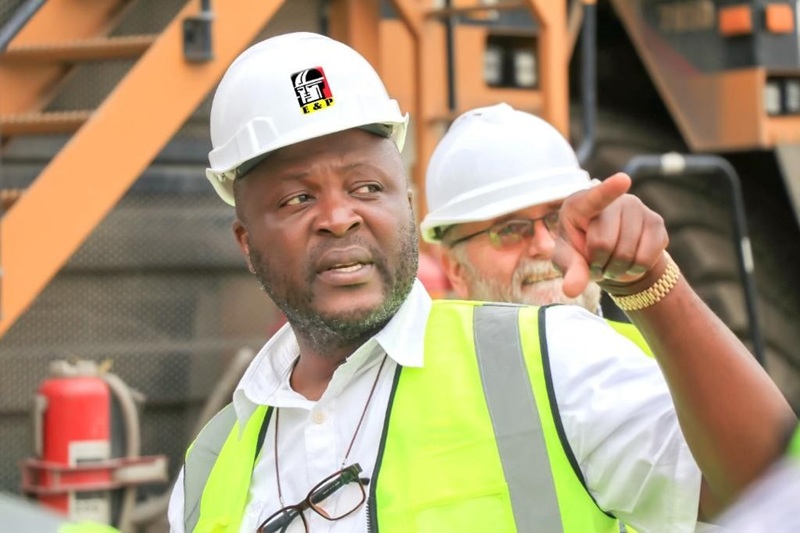
The recommendation to hand over operations of the Damang Gold Mine to Engineers and Planners Limited (E&P), a company owned by businessman Ibrahim Mahama, a brother of President John Dramani Mahama, has ignited a fierce political debate, with the opposition accusing the government of orchestrating a pre-determined process to benefit the President’s family.
The controversy follows the submission of a report by a Tender Committee established under the Minerals and Mining (Licensing) Regulations, L.I. 2176, which named E&P as the highest evaluated bidder after a competitive tender process. The committee’s recommendation now awaits final approval from the Ministry of Lands and Natural Resources.
This is the second major mining concession to be taken over by Ibrahim Mahama’s E&P, having hostilely acquired Azumah Resources Ghana Ltd., with some analysts framing them as ‘State Capture”.
Critics, particularly members of the opposition New Patriotic Party (NPP), have strongly challenged the credibility of the process of handing over the lucrative Damang mine valued at $15 billion, alleging that the outcome was predetermined.
They argue that the speed of the evaluation — reportedly completed within seven days — raises questions about transparency and due diligence.
Some have described the process as a “cover-up” designed to legitimise what they claim was an already decided plan to transfer the strategic national asset to Ibrahim Mahama, brother of John Mahama.
The accusations have also drawn on past political rhetoric, with opponents recalling how Mahama, while in opposition, criticised former President Nana Addo Dankwa Akufo-Addo over alleged family involvement in state-related businesses.
The NPP now argues that the current development represents a contradiction of those earlier positions, escalating the issue into a broader debate over governance, conflict of interest, and state asset control.
However, the National Democratic Congress government-aligned voices and defenders of the process insist the selection of E&P followed strict legal and technical procedures.
According to details of the Tender Committee’s report, four companies — Vortex Resources Mining Group, Engineers and Planners Limited, Heath Goldfields Ltd, and Maripoma Mining Services Ltd — submitted bids.
Out of these, only E&P and Heath Goldfields met the mandatory requirements in the initial evaluation phase.
The disqualification of the other two firms was attributed to their failure to provide key documentation, including proof of Ghanaian ownership, valid tax clearance, SSNIT and VAT certificates, and other statutory requirements.
This rendered their bids non-responsive under the rules governing the tender process.
Further assessment of the remaining bids considered criteria such as technical expertise, operational methodology, experience in similar mining projects, staff qualifications, equipment capacity, safety standards, and local content participation.
The committee concluded that E&P outperformed its competitors across these benchmarks.
Supporters of the decision also point to E&P’s long-standing involvement with the Damang mine.
The company has been engaged in mining services at the site since 2002, initially as a subcontractor before becoming a key operator from 2016. Its familiarity with the mine’s operations has been cited as a major advantage in ensuring continuity and preventing disruptions after the exit of Gold Fields Ghana Limited.
Historical records further indicate that discussions around E&P’s potential takeover began years before the current administration.
Following a demobilisation notice issued by Gold Fields in September 2023, E&P formally applied to the government in March 2024 for a “no objection” approval to explore a takeover pathway. This request was granted by the then Lands Minister, Samuel Abu Jinapor.
Subsequent engagements between Gold Fields, the Ministry of Lands and Natural Resources, and E&P led to the formation of a transition framework aimed at ensuring a seamless transfer of operations.
In November 2025, Gold Fields formally recommended E&P to continue operating the mine beyond the expiry of its lease in April 2026, reinforcing the company’s position in the process.
The Damang mine itself has a long operational history, having been run by Gold Fields since 1993, with the company holding a 90 percent stake while the Government of Ghana retains a 10 percent free carried interest under the Minerals and Mining Act, 2006.
Parliament had earlier approved a one-year transitional lease in 2025 to allow for a structured handover of the asset.
Government sources maintain that the transition is part of a broader strategy to ensure local participation and sustained productivity in Ghana’s mining sector.
They argue that involving a Ghanaian-owned company with proven operational capacity aligns with national objectives of value retention, job protection, and industry stability.
Despite these assurances, the political backlash continues to intensify, with sections of the opposition calling for scrutiny from civil society organisations, the media, and religious bodies.
They have also hinted at revisiting the decision should there be a future change in government.
About the Author