

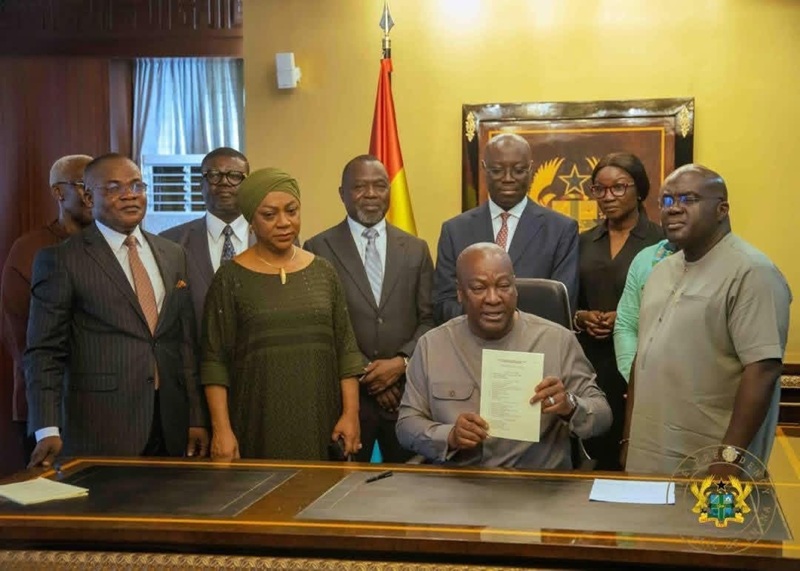
President John Dramani Mahama has assented to the Legal Education Reform Bill, 2026, ushering in a new era for legal education in Ghana and effectively ending the 66-year exclusive hold of the Ghana School of Law over professional legal training.
The newly enacted legislation is set to widen access to professional legal education by empowering accredited universities and institutions to offer professional law programmes, a mandate that had long been reserved solely for the Ghana School of Law.
For decades, critics had expressed concerns over the limited access to professional legal education in the country, especially the challenges surrounding admission into the Ghana School of Law.
Many qualified LLB graduates were unable to advance their legal careers due to inadequate admission capacity and the competitive entrance examination process.
Speaking after signing the bill into law on Monday, May 11, President Mahama stated that the legislation seeks to regulate legal education while maintaining high standards while also creating more opportunities for legal training in Ghana.
According to him, the reform is one that many aspiring lawyers across the country had eagerly anticipated.
Before the passage of the new law, the Ghana School of Law was the only institution authorised to run the Professional Law Course required for qualification and call to the Bar in Ghana.
That arrangement, which had existed for more than six decades, became a recurring subject of public debate, with students, legal professionals and civil society groups advocating reforms to make legal education more inclusive and accessible.
The enactment of the Legal Education Reform Bill, 2026 is therefore being hailed as a significant milestone in addressing those longstanding concerns.
Under the new legal framework, universities and institutions that satisfy the prescribed standards and secure approval from the appropriate regulatory authorities will now be allowed to provide professional legal education programmes.
Meanwhile, Attorney General, Dr. Dominic Ayine has disclosed that government will immediately commence implementation of the reforms following the President’s assent to the bill.
Addressing journalists at a post-signing press conference on Tuesday, Dr Ayine announced that the first major step would be the dissolution of the General Legal Council and the establishment of a new Council for Legal Education and Training to supervise legal education in the country.
“Implementation will begin without delay,” the Attorney General stated after confirming that President Mahama had signed the bill into law.
According to him, the newly created council will take over responsibility for regulating and accrediting institutions that intend to offer the Law Practice Course for LLB graduates seeking qualification to the Bar.
Dr Ayine described the legislation as a long-awaited reform aimed at fundamentally transforming legal education and ensuring equal opportunities for all persons aspiring to become lawyers in Ghana.
He further revealed that the establishment of the new council and the accreditation of institutions are expected to be completed before the end of the year.
The Attorney General also disclosed that government intends to support the implementation of the reforms financially through the 2027 national budget, which Cassiel Ato Forson is expected to present to Parliament later this year.
About the Author