

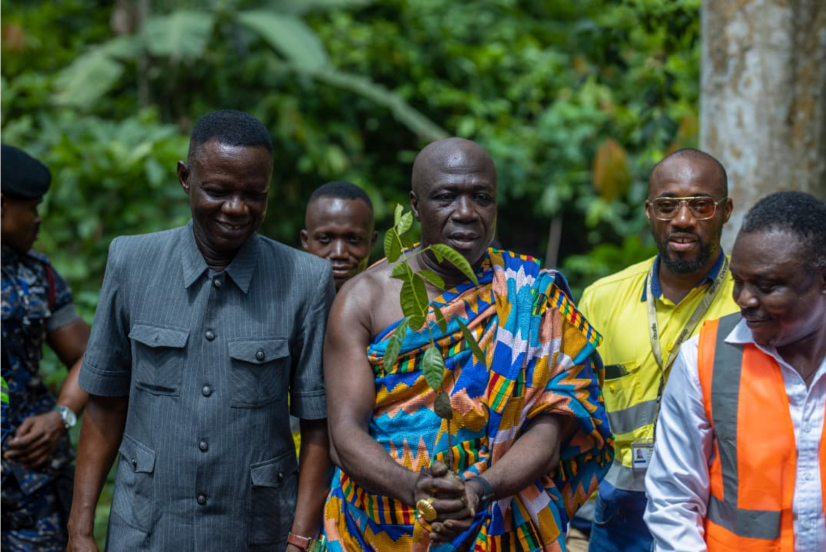
Asante Gold Chirano Limited (AGCL) has launched a US$7 million reforestation programme to restore about 800 hectares of degraded land within the Tano-Suraw Forest Reserve, marking one of the largest forest rehabilitation initiatives linked to mining offsets in recent years.
The project, to be implemented over a 10-year period, is expected to create more than 350 jobs for residents of surrounding communities while rehabilitating forest areas affected by human activity and environmental degradation.
The initiative forms part of AGCL’s reforestation offset agreement with the Forestry Commission, under which the mining company is required to restore forest land as compensation for areas disturbed by its operations.
Speaking at the launch, General Manager of AGCL, Ing. Stephen Asante Yamoah, said the programme reflects the company’s commitment to balancing mineral extraction with environmental stewardship.
He noted that the company is investing significant financial and technical resources into the project as part of its broader sustainability agenda.
According to him, the initiative extends beyond tree planting and seeks to restore degraded ecosystems, protect watersheds, improve biodiversity and rebuild habitats for wildlife.
He added that the programme would also contribute to climate change mitigation through carbon sequestration.
“The long-term objective is to ensure that economic development and environmental protection go hand in hand, creating benefits for both current and future generations,” he said.
Western North Regional Minister, Wilbert Petty Brentum, described the project as a significant intervention that combines environmental restoration with livelihood creation.
He said the programme would help safeguard natural resources while generating employment opportunities for communities within the project area.
The National Director of Operations, Plantations, at the Forestry Commission, Valerie Fumey Nassah, said the Tano-Suraw Forest Reserve was selected because of its ecological importance and the need to reverse degradation in sections of the reserve.
She explained that the reforestation effort is intended to offset the environmental impact of mining activities through deliberate forest restoration, biodiversity recovery and long-term ecosystem protection.
“The agreement seeks to ensure that areas affected by mining are compensated for through sustainable restoration measures that strengthen the resilience of the natural environment,” she said.

Traditional authorities have also thrown their support behind the initiative.
Acting President of the Wiawso Traditional Council, Nana Ofori Ahenkan II, urged beneficiary farmers and community members to take ownership of the project and protect the trees after planting.
He called on residents of Akoti, Etwebo, Paboase, Nsuonsua and Anglo to support the programme, stressing that its success would depend on sustained community participation and stewardship.
The project comes amid increasing scrutiny of the environmental footprint of mining activities and growing pressure on extractive companies to demonstrate tangible commitments to land rehabilitation and biodiversity conservation.
AGCL noted that the reforestation programme represents a long-term effort to restore degraded forest landscapes while creating economic opportunities for host communities.
About the Author