

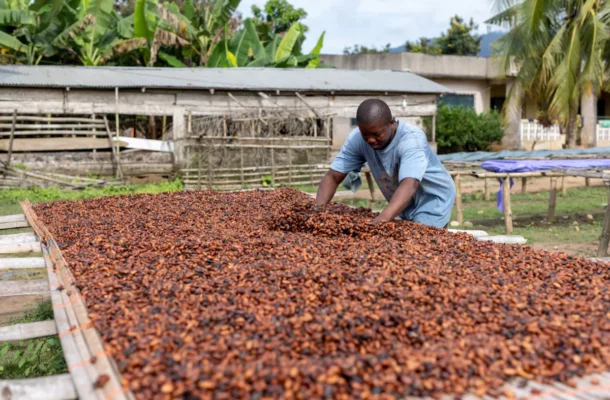
Former Member of Parliament for Sefwi-Wiawso, Kwaku Afriyie, has called for a broader national dialogue on cocoa value addition, urging the government to ensure that market forces function effectively while Ghana maximises returns from its cocoa sector.
Speaking in an interview on Adom FM’s morning show Dwaso Nsem, Dr. Afriyie stressed that proposals on value addition should be critically examined rather than accepted at face value.
“They should make sure market forces work properly. They should bring everything on board for us to discuss,” he stated.
He noted that global cocoa pricing is heavily influenced by market dynamics, including the activities of speculators, which policymakers must take into account. “Already there are speculators in the market. That is one area we need to work on,” he added.
Dr. Afriyie also highlighted the dominance of a few multinational firms in the global cocoa trade. According to him, about seven major companies control much of the industry’s value chain. “It is a $40 billion industry, yet Ghana and Côte d’Ivoire, at the end of the cocoa season, do not get more than $7 billion,” he argued.
While the government has promoted value addition and increased local processing as a pathway to higher earnings, the former MP urged caution.
“They say value addition and want to process more cocoa locally. We need to interrogate that,” he said. “If you concentrate only on cocoa butter and cocoa powder and you are not careful, we may not get the expected returns.”
He questioned the tangible benefits Ghana has derived from domestic processing so far. “About 40 percent of cocoa is being processed here. What value has it truly brought us?” he asked, urging stakeholders in industrial enclaves, cocoa processing companies and free zones to assess the actual gains from local value addition.
Dr. Afriyie further noted that Ghana’s cocoa enjoys a global reputation for premium quality, suggesting that under certain market conditions, exporting raw beans could generate better returns than limited value-added processing arrangements.
“Ghana produces quality cocoa. Sometimes, depending on market conditions, you may realise that exporting the beans could bring in more value than processing them under certain arrangements. It is a very difficult issue,” he explained.
His remarks come amid ongoing debates over cocoa pricing, as the government maintains that the revised producer price reflects global market fluctuations and inherited financial obligations, while some cocoa-growing communities continue to call for relief.
About the Author