
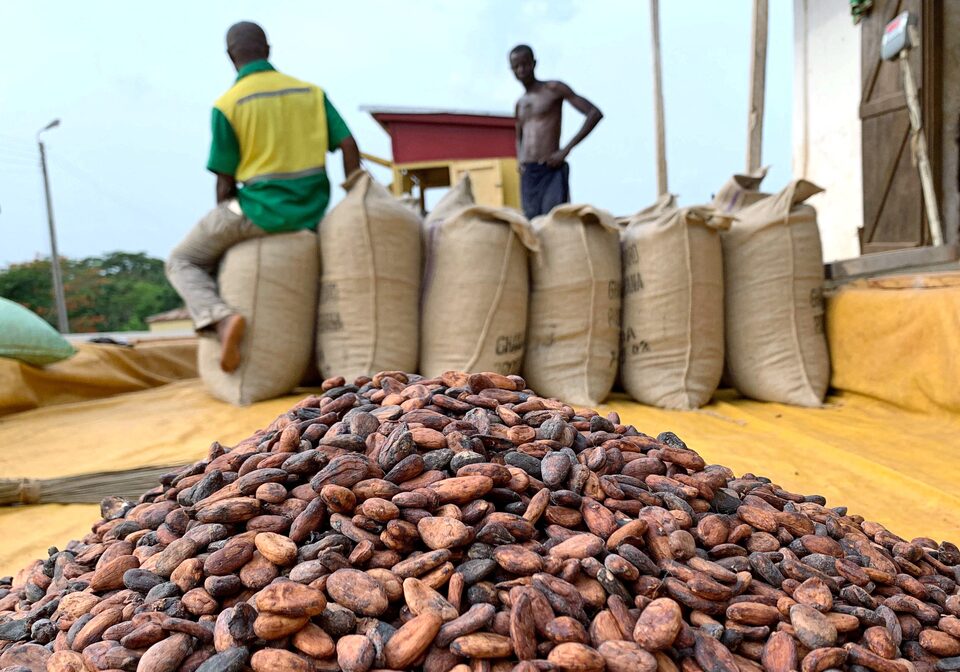
The recent reduction of Ghana’s cocoa producer price has reignited political debate, with the National Democratic Congress (NDC) attributing the crisis in the cocoa sector to alleged financial mismanagement under the previous New Patriotic Party (NPP) administration.
Speaking during a “Thank You” tour in the Upper Denkyira West Constituency of the Central Region, NDC National Chairman, Johnson Asiedu Nketiah, claimed that the former government left a “mess” in the sector that contributed to the government’s decision to cut prices.
According to Asiedu Nketiah, the NPP government had secured a loan to purchase 800,000 tonnes of cocoa for the 2023/2024 crop season but bought only slightly over 400,000 tonnes while utilizing the full loan amount.
“When it was time to repay the banks, the government didn’t have the required quantity of cocoa and had to request a rescheduling of the loan to 2025,” he said.
The NDC chairman also alleged that the NPP had raised additional funds from domestic banks using cocoa bonds but failed to meet repayment obligations.
“They used the same cocoa bond to collect lots of money from domestic banks. As a result of the haircut, the same government later admitted it could not pay the banks. So, when we took over, our audit revealed this was the mess left behind,” Asiedu Nketiah stated.
He further criticized past practices that allegedly inflated costs, including the importation of large quantities of jute sacks for cocoa packaging, which he claimed were used as a medium for financial gain by political cronies.
According to him, many sacks remain at the ports, enough to last the country a decade without further imports.
Fiifi Boafo: Cocoa Price Cut An Act of Cruelty
The price reduction, approved by the Producer Price Review Committee (PPRC) and effective from February 12, 2026, set the cocoa producer price at GH¢41,392 per tonne, equivalent to GH¢2,587 per bag.
Former Head of Public Affairs at COCOBOD, Fiifi Boafo, has criticized the government’s approach, describing the reduction as “an act of cruelty against cocoa farmers.”
Speaking on Big Issue on Channel One TV, Boafo argued that the engagement around the price cut has been poorly handled, with farmers being “taken for granted” and disrespected.
“The reduction is out of cruelty against the cocoa farmers,” he said, adding that government and COCOBOD officials failed to consider the implications of the price cut on the livelihoods of farmers.
NDC Celebrates Cocoa Revenue Growth
Supporters of the NDC have pointed to cocoa revenue increases following the party’s assumption of office in 2025.
According to Bank of Ghana data, cocoa export revenue more than tripled from $579 million to $1.84 billion in just four months, surpassing the total revenue received in 11 months under the previous government.
The NDC attributed this rapid growth to measures including the crackdown on illegal mining, which helped preserve cocoa farms, and the sale of cocoa at spot prices, which they argued boosted revenue.
Critics, however, question the plausibility of attributing such dramatic production gains to only four months of governance, arguing that it exaggerates the party’s achievements while deflecting responsibility for the current price cut.
Calls for Technical Competence In Cocoa Administration
Amid the political debate, media personality Paul Adom-Otchere emphasized the need for technical expertise in critical positions, including COCOBOD.
Speaking on The Big Issue, he cautioned against appointing politically connected individuals without the necessary skills to manage technically demanding roles.
“The issue at COCOBOD is bringing to the fore the conversation that politicians must understand that when a new government takes over and distributes political positions, some of these positions are purely technical. You can take your person there, but make sure that such a person is technically competent,” he noted.
Paul Adom-Otchere argued that the cocoa price reduction controversy highlights the consequences of prioritizing political loyalty over technical competence in leadership positions critical to the cocoa sector.
About the Author