
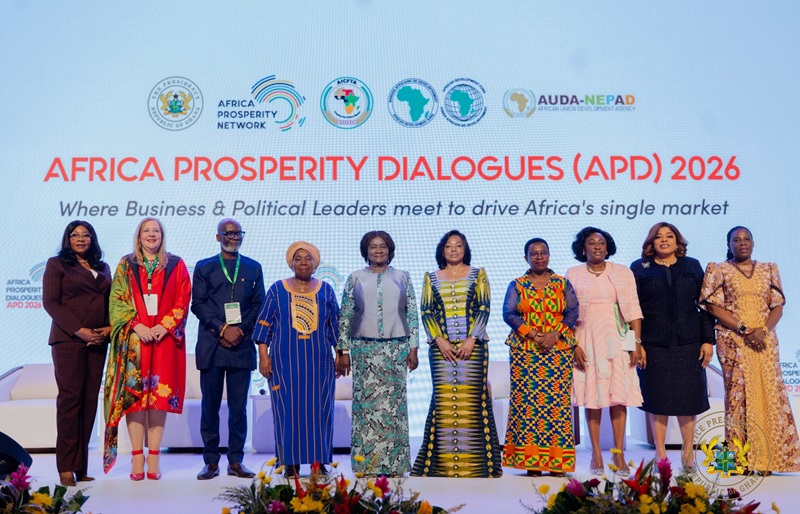
Women leaders from across academia, business, finance, governance, and civil society have taken centre stage in advocating for Africa’s economic integration under the African Continental Free Trade Area (AfCFTA).
Their call came during a high-level panel discussion at the 2026 Africa Prosperity Dialogues (APD), held on Wednesday, February 4, 2026, at the Accra International Conference Centre (AICC).
The event, themed “From Boardrooms to Borders: Women Driving the AfCFTA Agenda”, brought together distinguished women leaders who shared insights on strategies to empower women entrepreneurs, enhance trade policy, and strengthen inclusive growth across the continent.
The discussion comes amid renewed continental efforts to operationalize AfCFTA protocols, aimed at boosting intra-African trade and leveraging Africa’s collective economic potential.
Partnerships and Collaboration As Catalysts For Growth
Professor Nana Aba Appiah Amfo, Vice-Chancellor of the University of Ghana, emphasized that strategic collaboration is essential for preparing young people and women to fully exploit AfCFTA opportunities.
She noted that while universities play a central role in research and skills development, the impact of such initiatives is amplified through partnerships with industry and international institutions.
“Our fourth strategic priority is engagement and partnerships because we recognize that whatever we want to achieve, we cannot do it on our own,” Prof. Amfo said.
She cited the University of Ghana’s recently launched innovation enclave and maker space as a successful example of collaboration with local and global partners, underscoring the importance of multi-sector engagement in building Africa’s economic future.
From Cocoa Price Takers To Value Negotiators
Patricia Poku Diaby, Executive Chair of Plot Enterprises and a member of the Africa Prosperity Network (APN) Advisory Council, highlighted Africa’s continued dependence on exporting raw commodities without commanding pricing power.
Focusing on the cocoa sector, she stressed that while West Africa—including Ghana and Côte d’Ivoire—produces over 60 percent of the world’s cocoa, the continent largely remains a price taker.
“We feed the industry, but in spite of this dominance, we don’t influence anything—neither pricing nor even the market,” she said.
Poku Diaby called for increased value addition and stronger continental cooperation, noting that cocoa is not only Ghana and Côte d’Ivoire’s economic backbone but also a livelihood source for over 44 million families globally.
Building Financial Systems To Empower Women Traders
Pearl Nkrumah, Managing Director of Access Bank Ghana, stressed the importance of robust financial infrastructure and seamless payment systems to enable women-led trade under AfCFTA.
She argued that cross-border trade can only thrive when transactions are simple, efficient, and accessible, particularly for women entrepreneurs.
“For women trading among ourselves, the key question is how do we enable platforms that make it smooth and fluid for a woman in Ghana to ship products to other countries and receive payment back seamlessly,” Nkrumah said.
She called for strengthened trade ecosystems—including marketplaces, procurement networks, and digital payment systems—to help women-owned businesses scale and integrate into regional and global supply chains.
Policy Support For Informal Cross-Border Women Traders
Nana Oye Bampoe Addo, Deputy Chief of Staff for Administration at the Office of the President of Ghana, highlighted that women dominate informal cross-border trade, accounting for nearly 70 percent of such transactions across Africa.
She emphasized the need for AfCFTA policies that directly address the challenges informal traders face, including regulatory barriers, inefficient payment systems, and cumbersome border procedures.
Leveraging The African Diaspora For Continental Growth
Professor Marie-Line Sephocle, Founder of the Women Ambassadors Foundation, urged African leaders to harness the wealth, knowledge, and networks of the African diaspora, particularly in the Americas.
She pointed to over 30 African American-owned banks and more than 100 universities in the U.S. alone as untapped resources that could support trade, investment, and development initiatives on the continent.
“Engaging the diaspora is not just about capital—it’s about knowledge, networks, and influence that can accelerate Africa’s trade and development objectives,” Prof. Sephocle said.
She called for strategic engagement with diaspora institutions, citing Howard University as an example of the educational and social capital that can be leveraged to advance Africa’s economic agenda.
Context
Since its operationalization in 2021, the African Continental Free Trade Area has aimed to create a single continental market for goods and services, facilitating free movement of businesspersons and investments across Africa.
Despite these gains, women—who make up a significant portion of informal trade—have often faced systemic barriers, including limited access to finance, cross-border restrictions, and weak integration into regional value chains.
The APD 2026 panel sought to address these gaps, emphasizing the transformative role women can play in realizing AfCFTA’s vision.
About the Author