
A wave of politically charged petitions seeking the removal of key constitutional officeholders in Ghana has formally collapsed, after the Chief Justice ruled that none of the complaints met the constitutional threshold required to trigger investigations or removal proceedings.
In a decisive development that effectively ends the process, the Chief Justice, Paul Baffoe-Bonnie, has determined that no prima facie case exists in petitions targeting the leadership of the Electoral Commission and the Office of the Special Prosecutor.
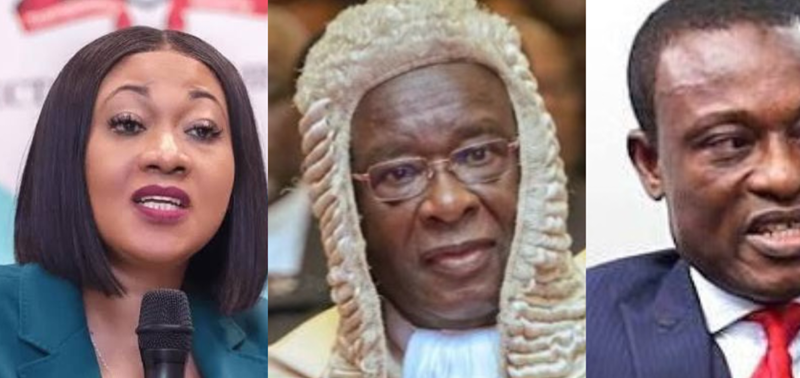
The decision follows a formal constitutional process initiated after President John Dramani Mahama received a total of ten petitions—seven calling for the removal of the Chairperson of the Electoral Commission, Jean Mensa and her two Deputies, Dr Bossman Asare and Samuel Tettey; three separate petitions seeking the removal of the Special Prosecutor, Kissi Agyebeng.
The petitions were submitted by various individuals and groups amid growing political tensions and public debates over the independence and credibility of state institutions.
In line with Article 146 of the 1992 Constitution and Section 15 of the Office of the Special Prosecutor Act, 2017 (Act 959), the President referred all the petitions to the Chief Justice on November 25, 2025.
Under the constitutional framework, the Chief Justice’s role at this stage is not to investigate the allegations, but to determine whether the petitions disclose a prima facie case—meaning whether there is sufficient legal basis to justify the establishment of a formal committee of inquiry.
By a formal letter dated January 26, 2026, the Chief Justice informed the President that none of the petitions met this constitutional threshold.
According to the determination, the allegations failed to disclose sufficient grounds to justify any further proceedings toward the removal of the Electoral Commission Chairperson, her Deputies, or the Special Prosecutor.
The Presidency made the outcome public in a statement issued on Wednesday, February 18, 2026, confirming that the petitions had been dismissed at the preliminary stage.
The statement was signed by Felix Kwakye Ofosu, Spokesperson to the President and Minister for Government Communications.
This decision brings a definitive end to the removal attempts, as the Constitution provides no further avenue once the Chief Justice finds that no prima facie case exists.
Without this threshold being met, no investigative committee can be constituted, and no impeachment or removal process can lawfully proceed.
The failed petitions emerged against a broader background of heightened political contestation over state institutions.
In recent years, the Electoral Commission has been at the centre of electoral reforms, boundary realignments, and politically sensitive electoral disputes, while the Office of the Special Prosecutor has increasingly become a focal point of national debate due to its high-profile corruption investigations involving politically exposed persons.
The Special Prosecutor’s office, in particular, has faced sustained political pressure, including parliamentary initiatives seeking to abolish or restructure the institution, alongside public legal challenges to its independence.
Similarly, the Electoral Commission’s leadership has been the subject of repeated political criticism, especially in the context of election management and constituency demarcations.
About the Author