

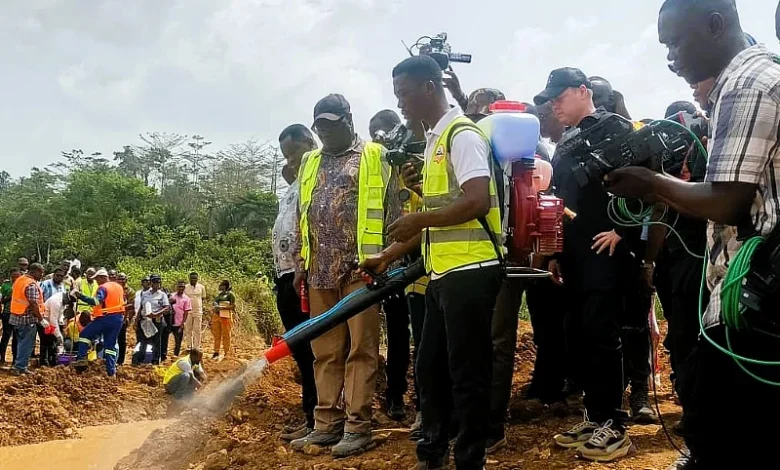
Ghana’s Environmental Protection Authority (EPA) has launched a pilot project to rehabilitate a heavily polluted section of the Birim River at Adiukrom, in the country’s Eastern Region, as part of intensified national efforts to tackle water contamination caused by illegal gold mining.
The initiative, which began on February 24, 2026, is designed to demonstrate science-based and scalable solutions for restoring degraded waterways, while strengthening long-term water resource management in West Africa’s leading gold-producing nation.
Illegal small-scale mining—locally known as *galamsey*—has severely impacted several of Ghana’s major rivers, including the Birim. The practice often involves the unregulated use of heavy machinery and chemicals, leading to high levels of sedimentation and toxic pollution. The resulting degradation threatens aquatic ecosystems, rural livelihoods, and access to safe drinking water for downstream communities.
Multi-Agency Scientific Collaboration
The pilot project brings together a coalition of national scientific and regulatory institutions, including:
* The Ghana Water Company Limited (GWCL)
* The Water Resources Commission (WRC)
* The Water Research Institute under the Council for Scientific and Industrial Research (CSIR-WRI)
* The Ghana Atomic Energy Commission (GAEC)
* The Ghana Standards Authority (GSA)
* SciencePlus and Eillish Solutions
This multi-agency collaboration reflects a coordinated, data-driven approach that combines environmental science, water quality monitoring, regulatory enforcement, and technical innovation.
A Model for National and Regional Replication
According to the EPA, the Adiukrom intervention is intended not only to restore the affected stretch of the Birim River but also to serve as a proof of concept for broader national application. If successful, the model could inform future river restoration projects across Ghana and potentially provide lessons for other countries in West Africa grappling with mining-related environmental damage.
The project forms part of Ghana’s wider strategy to protect critical water resources, strengthen environmental governance, and promote sustainable development in the face of climate and ecological pressures.
By prioritizing institutional coordination and scientific intervention, authorities hope the Birim River pilot will mark a turning point in the country’s fight against environmentally destructive mining practices.
About the Author