
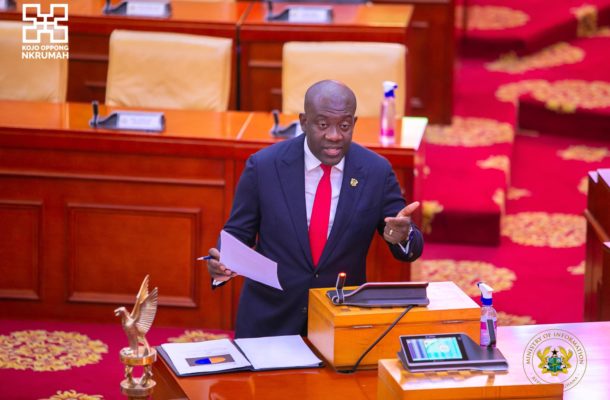
Growing concerns over parliamentary oversight and constitutional accountability have pushed the Minority in Parliament toward a possible legal showdown with the Executive, as Kojo Oppong Nkrumah, Minority Spokesperson on Parliament’s Economy and Development Committee, revealed that the caucus is considering legal action at the Supreme Court of Ghana to compel the government to formally present its policies and programmes to the Parliament of Ghana for scrutiny.
Speaking in a televised interview on TV3 Ghana on February 22, 2026, the Ofoase-Ayirebi MP disclosed that the Minority is exploring the option of seeking a judicial declaration to enforce what it believes is a clear constitutional requirement.
According to him, government initiatives and programmes must, by law, be laid before Parliament to enable effective oversight, transparency, and accountability in governance.
Oppong Nkrumah grounded his argument in Ghana’s constitutional framework, spe²⁷cifically referencing Article 36(5) of the 1992 Constitution, which mandates that governments, upon assuming office, present their development programmes to Parliament.
He stressed that Parliament, as the representative body of the people, has a constitutional duty to scrutinise government policies, allocate resources through the budgetary process, and monitor implementation to ensure that programmes meet their stated objectives.
He explained that the formal presentation of programmes is not a mere procedural ritual but a critical governance tool that allows Parliament to track performance, assess impact, and hold the Executive accountable.
Without such documentation, he argued, lawmakers are denied the ability to perform meaningful oversight, weakening democratic checks and balances and undermining public confidence in governance.
Placing the issue in a historical and institutional context, the Minority Spokesperson noted that successive governments have traditionally laid major policies and programmes before Parliament, making the current situation a troubling departure from established democratic practice.
He accused the present administration of systematically failing to comply with this constitutional obligation, despite repeated demands from Parliament.
“What is happening is that the government is literally refusing to bring its policies and programmes to Parliament,” he stated, adding that the absence of formal programme documents makes it impossible for Parliament to interrogate government initiatives or assess their outcomes properly.
He described the situation as a direct assault on Parliament’s oversight role and a dangerous precedent for democratic governance.
Oppong Nkrumah revealed that the Minority has been tracking government initiatives and has identified about 17 programmes that have been launched publicly.
However, he noted that only one—the 24-hour economy programme—has been formally brought before Parliament, and even that, he said, came only after sustained pressure from the Minority, and after a bill had already been introduced ahead of the programme document itself.
He cited several high-profile initiatives that, according to him, have not been presented to Parliament, including the National Apprenticeship Programme, Feed Ghana, and Nkoko Nkitinkiti (linked to cocoa sector reforms), describing their absence from parliamentary records as a serious governance gap that weakens accountability and transparency.
The Minority Spokesperson warned that the continued sidelining of Parliament in policy formulation and programme presentation risks turning the legislature into a ceremonial institution rather than an effective oversight body.
He argued that without access to official programme frameworks, Parliament cannot properly appropriate funds, monitor implementation, or evaluate whether government initiatives are achieving their intended social and economic outcomes.
The proposed move to the Supreme Court, if pursued, would mark a significant constitutional test of executive accountability in the democratic system. It would seek to clarify the legal obligation of governments to submit their policies and programmes to Parliament and could redefine the balance of power between the Executive and Legislature.
About the Author