
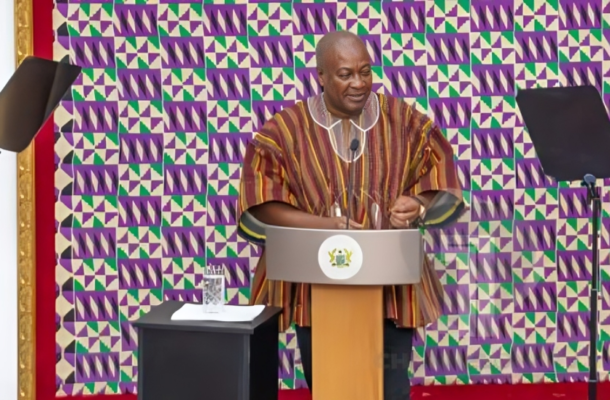
In a national address that framed economic performance as a turning point in the recovery trajectory, President John Dramani Mahama announced sweeping gains in employment creation and poverty reduction, describing the period between the first and third quarters of 2025 as one of the most significant phases of socio-economic improvement in recent years.
The address, delivered on Friday, February 27, positioned the government’s economic strategy as moving beyond policy design into full-scale implementation, with measurable impacts on livelihoods across the country.
Drawing on official data from the Ghana Statistical Service, President Mahama disclosed that more than one million Ghanaians secured employment within the nine-month period, while approximately 950,000 citizens exited what is defined as multidimensional poverty — a measure that goes beyond income to include access to education, healthcare, housing, and basic services.
According to the figures cited, these outcomes reflect a broad-based improvement in living standards rather than isolated sectoral growth.
The President linked these gains to a wider economic transition agenda, noting that the government’s flagship 24-hour economy policy — long discussed during campaign and policy planning stages — is now entering a practical phase of execution.
He described the shift as a movement from “planning to action,” arguing that the current employment figures are early indicators of the policy’s long-term potential to expand productivity, stimulate private sector participation, and stabilize household incomes.
Beyond domestic employment and social indicators, Mahama highlighted what he termed a “structural turnaround” in the external sector. By December 2025, he said, the country recorded a current account surplus of $9.1 billion, representing 8.1 percent of Gross Domestic Product — a dramatic rise from the 1.8 percent recorded in 2024.
This, he explained, signals renewed macroeconomic stability after years of fiscal pressure, currency volatility, and balance-of-payment constraints.
The President attributed the improved external position to strong export performance in key traditional sectors such as gold and cocoa, alongside growth in non-traditional exports and increased remittance inflows from the Ghanaian diaspora.
These combined inflows, he noted, have strengthened foreign exchange reserves and contributed to greater resilience in the national economy.
Placing the announcement in historical context, Mahama referenced previous periods of economic strain marked by rising unemployment, currency depreciation, and declining purchasing power, which had deepened public discontent and heightened pressure on successive administrations.
He argued that the current data represents a reversal of those trends, suggesting that Ghana is entering a phase of recovery driven by production, trade expansion, and employment-led growth rather than consumption-driven borrowing.
The address also carried strong political significance, reinforcing the governing National Democratic Congress narrative that economic stabilization must translate into tangible improvements in daily life.
By linking macroeconomic indicators directly to job creation and poverty reduction, the President sought to frame national economic performance not only in statistical terms but in human impact — livelihoods restored, households stabilized, and communities lifted from vulnerability.
About the Author