
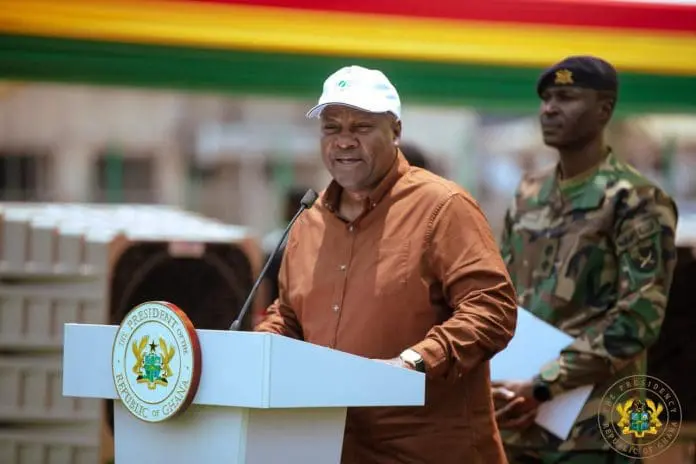
President John Dramani Mahama has clarified that the ban on preaching and hawking in moving vehicles is intended to address safety concerns and not to prevent religious activities in stationary vehicles.
His comments follow concerns from sections of the public, particularly Christian leaders, over restrictions on preaching in public transport.
Speaking during a tour, President Mahama said preaching could take place when a bus was at a station but should stop once the vehicle began moving.
“I have been hearing that we are going to ban people from preaching on buses. That’s not true. We didn’t say that. If the bus is at the station, you can preach, but if the bus starts moving, no one should preach or start hawking because the driver’s attention would be on what you are saying.
“Apart from that, if the driver steps on the brake while you are standing in the bus, you can be hurt. So, it’s a law that has been there for a very long time. But the new law passed by Parliament, the road regulations, succeeds the L.I. The L.I., which has been in existence for several years, prevents people from hawking or preaching, regardless of religion, in moving vehicles,” he said.
The President explained that the restriction was intended to protect passengers and prevent activities that could distract drivers while on the road.
The debate over the restriction has centred on concerns that the law could limit religious expression, particularly the activities of pastors who preach to passengers on public transport.
Meanwhile, the government has suspended the implementation of the Legislative Instrument (L.I.) on preaching and hawking in moving vehicles pending further stakeholder engagement.
The suspension follows public concerns over the restrictions, with the government expected to engage relevant stakeholders on the matter.
About the Author