

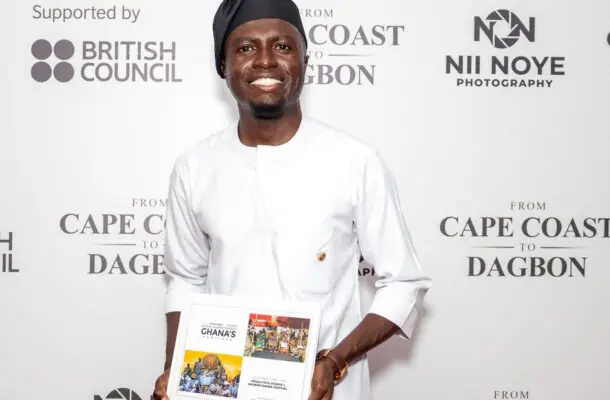
A new photobook by Ghanaian photographer Andrew Nii Noye documents the Damba Festival in Dagbon and the Oguaa Fetu Afahye in Cape Coast, aiming to preserve cultural practices, history and symbolism for future generations.
From Cape Coast to Dagbon: A Visual Journey Through Ghana’s Heritage was launched at the British Council in Accra on Thursday, October 22, after more than a year of work by Nii Noye. The publication was edited by Dr Patricia Serwaa Afrifa, who holds a PhD in African Studies from the University of Ghana, Legon.
The book records ceremonies, regalia, drumming and dancing, while also exploring the stories and beliefs behind the public celebrations. It is intended to support cultural education, tourism, research and the work of students and cultural institutions.
“I wanted to start a project documenting some of our festivals and cultural activities to augment the information that is already out there,” Nii Noye said. “This is to support educational institutions, international cultural organizations in the country, and promote tourism as well.”
He said the project was prompted by the lack of attention paid to the meaning behind many traditional practices.
“Beyond the clothing, beyond the drumming, beyond the dancing, there are stories behind them,” he said. “With the pictures I took, I realized it will be able to support in telling the stories behind them.”
The Oguaa Fetu Afahye is an annual celebration of the people of Cape Coast, while the Damba Festival is rooted in the history and customs of Dagbon. Bringing them together, the book presents two distinct traditions while showing how both express identity, history and community values.
Nii Noye documented the 2024 Damba Festival during the reign of the late Yaa Naa Mahama Abukari II. His death has given some of those images added historical significance.
“Since the passing of His Royal Majesty, Yaa Naa Mahama Abukari II, this book has taken on an even deeper meaning,” he said. “These images remind us that photography can preserve memories long after the moment itself is gone.”
Calls for greater cultural investment
Ghana Tourism Authority Deputy Chief Executive Officer Gilbert Abeiku Aggrey, popularly known as Abeiku Santana, said the country needed a stronger national effort to document its heritage.
“The best way to tell stories is through photography,” he said, warning that Ghana could lose important traditions without deliberate documentation. He cited Kente, recognised by UNESCO as Ghana’s intangible cultural heritage, as an example of a tradition whose significance was not always understood.
Mr Aggrey said cultural records could help younger generations in the digital age, when many people use the internet, ChatGPT or AI to find information. “We have a lot to tell but we don’t have anything to show, and pass it to our generation,” he said. “We may lose them.”
Dr Stephen Amoah, Member of Parliament for Nhyiaeso and a former Deputy Minister for Finance and Trade, praised Nii Noye for documenting cultural activities in the Central Region and Dagbon. He said the photographer, whom he had mentored for years, was motivated by social impact rather than money.
National Youth Authority Governing Board Chairperson Julian Mawuse Cobbinah also called for culture to be made more relevant to young people. She said greater documentation could strengthen ownership, identity and the sustainable development of Ghanaian traditions, at a time when foreign products and lifestyles were often viewed as symbols of status.
The launch was supported by the British Council in Accra and attended by GIZ Country Director Sandra Retzer and UNESCO Accra National Programme Officer for Culture Carl Ampah.
Nii Noye’s project is intended to create a lasting visual record for education, tourism and historical research.
About the Author