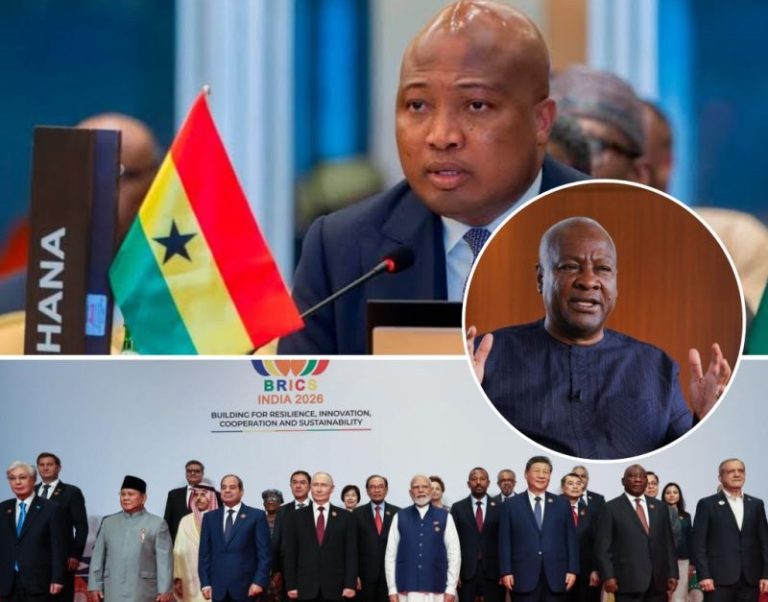

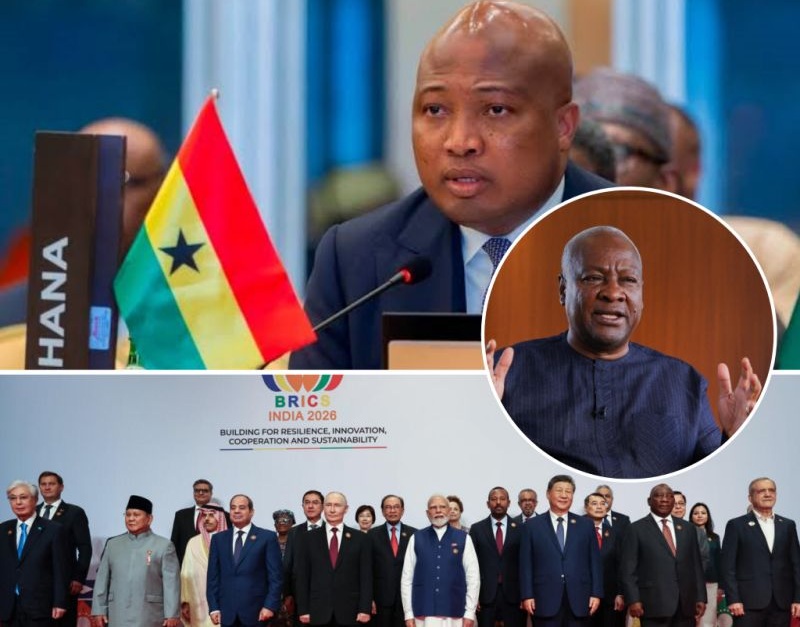
Ghana’s application to join BRICS is a strategic attempt to expand its economic and diplomatic options, rather than a decision to choose between Eastern and Western alliances.
Foreign Affairs Minister Samuel Okudzeto Ablakwa said on 6 October 2026 that Cabinet had approved the move, with the aim of diversifying partnerships, increasing economic opportunities and strengthening cooperation with the Global South. India, whose foreign minister was visiting Accra, has been asked to help Ghana through the application process.
The World Bank estimates Ghana’s 2025 GDP at $114.2 billion, following 6.0 percent growth, while the country’s population is 35.1 million. It is a middle-sized African state seeking greater room for manoeuvre, not a major power attempting to reshape global commerce.
BRICS now has 11 members, accounting for about 49 percent of the world’s population, 39 percent of global GDP and 23 percent of international trade. Its growing economic and geopolitical importance could give Ghana new opportunities in trade, investment and diplomatic coalition-building.
Membership is not guaranteed. The process moves from formal interest to possible membership and then full membership, with decisions taken by Sherpas, foreign ministers and leaders by consensus. Ghana must therefore secure political backing from existing members.
Economic opportunities and limits
Ghana already has substantial trade with BRICS economies, particularly China and India. Ghana-China trade reached a record $14.1 billion in 2025, an increase of 19.3 percent. China accounted for 45.9 percent of Ghana’s imports from Asia in 2024, while India supplied 13.7 percent.
That relationship offers potential but also exposes Ghana to concentration risks. A formal BRICS connection could support investment in processing, infrastructure, digital technology, energy and transport, helping the country move beyond exporting raw commodities while importing manufactured goods.
The New Development Bank, which has $52.7 billion in paid-in capital, could provide another source of development finance. However, BRICS membership would not resolve Ghana’s debt pressures, currency risks, weak productivity or dependence on commodities. Any project would still need to meet affordability, transparency and national-interest requirements.
The central benefit would be greater bargaining power. Stronger links with China, India, Brazil, the Gulf and other emerging economies could allow Ghana to negotiate more broadly with the United States and European Union. The purpose would be diversification and strategic autonomy, not replacing one dependency with another.
Security and diplomatic risks
BRICS is not a military alliance and offers no Article 5-style collective-defence guarantee. It is instead a political forum covering global governance, sanctions, development and the international order.
Ghana would not gain protection through BRICS against jihadist violence spreading south from the Sahel, insecurity in the Gulf of Guinea or cyber threats. Its existing Western security ties remain important. In August 2026, the Defence Ministry said US cooperation covered joint exercises, intelligence-sharing, counter-terrorism, maritime security and plans involving drone-based intelligence, surveillance and reconnaissance. In September, Ghana reaffirmed its partnership with Washington on logistics, institutional development, peacekeeping, cyber defence and maritime security.
Accra must also consider the diplomatic consequences of closer association with China and Russia, whose relations with the United States and its allies are strained, with Russia facing war-related sanctions. Ghana may come under pressure over sanctions, conflicts, technology standards and international norms.
Its application should therefore be conditional on preserving flexibility, credibility, ECOWAS commitments, African obligations and security cooperation with the United States and Europe. The key question is whether BRICS membership expands Ghana’s choices. If it does, the bid supports strategic autonomy; if not, it risks becoming dependency under a different flag.
The writer is a lecturer in journalism and media studies and the CEO of The International Lens.
About the Author