
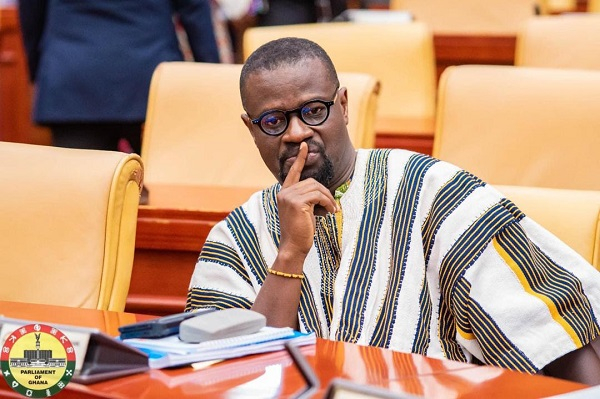
The Minority Chief Whip and Member of Parliament for Nsawam-Adoagyiri, Frank Annoh-Dompreh, has launched a blistering attack on the Majority in Parliament over what he described as poor management of parliamentary business, warning that the growing backlog of unanswered parliamentary questions, delayed government bills and hundreds of pending referrals are undermining Parliament’s constitutional oversight responsibilities.
Speaking during deliberations on the Business Statement on the floor of Parliament, Annoh-Dompreh argued that Parliament was failing to perform one of its core constitutional duties of holding the Executive accountable.
He maintained that scheduling only 27 parliamentary questions for the week, despite more than 200 outstanding questions, was unacceptable and a disservice to Ghanaians.
According to him, Parliament traditionally handles an average of about 77 parliamentary questions each week, making the decision to schedule only 27 questions particularly worrying, especially at a time when the 2026 Mid-Year Budget Review is expected to be presented on July 23.
“The people of this country are watching us,” he declared. “Out of more than 200 pending questions, you are advertising only 27. That cannot be accepted.”
The Minority Chief Whip stressed that many parliamentary questions lose their relevance when ministers fail to appear before the House to answer them on time.
He accused some government ministers of consistently failing to honour invitations to Parliament, thereby frustrating MPs’ oversight responsibilities.
Annoh-Dompreh urged the Majority Leader and Deputy Majority Leader to immediately review the parliamentary programme by bringing a supplementary Business Statement to increase the number of questions scheduled for ministers. He insisted that Parliament could and should do much better.
His criticism did not end there. The Nsawam-Adoagyiri legislator also expressed concern over the slow pace at which government legislation is reaching Parliament.
He recalled that Parliament had earlier been informed that approximately 69 government bills were expected before the House this session, yet only a handful had been presented.
He said the delay was slowing down Parliament’s legislative agenda and called on the Majority leadership to engage government ministers more aggressively to ensure they personally shepherd their respective bills before the House.
Drawing from his experience as a former Majority Chief Whip under the previous New Patriotic Party (NPP) administration, Annoh-Dompreh said the leadership at the time held regular meetings with ministers to monitor legislative business and ensure bills were submitted promptly.
He urged the current Majority leadership to adopt a similar strategy, saying Parliament’s primary constitutional responsibility is law-making and that unnecessary delays in presenting bills undermine governance.
The Minority Chief Whip also turned attention to what he described as one of the most troubling administrative challenges facing Parliament—the accumulation of more than 400 pending referrals awaiting committee consideration.
He described the situation as “an ugly history” that Parliament should not be proud of.
According to him, a significant proportion of the referrals consist of routine audit committee reports from Metropolitan, Municipal and District Assemblies, many of which have remained unattended to for months despite their importance in ensuring accountability within local government.
He questioned why Parliament continued to allow such reports to pile up instead of referring them promptly to the appropriate committees for consideration.
“Why are we doing this to ourselves?” he asked. “Every week we attach the same long list of pending referrals to the Business Statement without taking concrete steps to clear the backlog.”
Annoh-Dompreh further criticised what he described as poor planning of parliamentary business, arguing that Order Papers are often overloaded with motions and items that Parliament is not prepared to prosecute.
He said the practice wastes public resources through unnecessary printing while creating the false impression that Parliament is handling a heavy legislative workload.
“We advertise business we are not ready to take,” he remarked. “We are simply wasting paper instead of organising parliamentary work more efficiently.”
At one point during the debate, his comments sparked exchanges with members on the Majority side after he suggested they needed to become “more serious” in managing parliamentary business.
Following concerns raised by some colleagues, Annoh-Dompreh withdrew any remark that could be interpreted as questioning the commitment of individual members, saying he had no difficulty retracting words that offended colleagues.
However, he maintained the substance of his argument, insisting that Parliament must improve its efficiency. “I withdraw those words,” he told the House. “You are serious, but get more serious.”
About the Author