
Ghana’s plans to digitise historic film held in the United Kingdom have renewed calls for a wider national strategy to protect audiovisual archives, equipment and cinema facilities still at risk within the country.
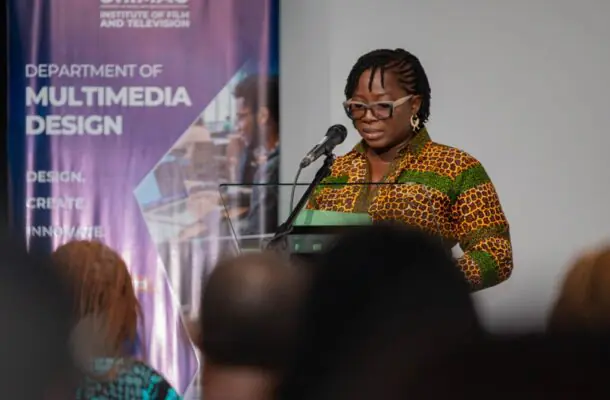
The issue was highlighted at a World Day for Audiovisual Heritage commemoration at the University of Media, Arts and Communication’s Institute of Film and Television (UniMAC-IFT) in Accra on Friday, 30 October.
Held under the theme “Your Window to the World”, the event was organised by UniMAC’s Faculty of Digital Media and Design in partnership with the United Nations Educational, Scientific and Cultural Organisation (UNESCO).
Faculty dean Dr Rebecca Ohene-Asah said the government, through the 24-Hour Economy Authority’s 24-hour-plus programme, had committed funding to digitise Ghanaian historical film preserved in the UK.
She said the work was already under way and would help recover recordings stored on obsolete analogue formats. However, she warned that attention must also be given to UniMAC’s own archive, which includes student productions dating back to 1978.
Many of those materials cannot currently be accessed because of the cost and technical difficulty of restoring and preserving them. Dr Ohene-Asah called for investment and partnerships to establish UniMAC as a national centre for audiovisual heritage preservation.
The Head of UNESCO’s Accra Office, Mr Edmond Moukala, said film, tapes and cassettes should be treated as national assets rather than outdated objects. He praised veteran filmmaker Rev. Dr Chris Hesse and encouraged efforts to place his collection on UNESCO’s national Memory of the World Register.
Moukala also referred to UNESCO’s Japan Fund-in-Trust project, “Advancing the Preservation and Accessibility of African Documentary Heritage at Risk”. The university librarian has received UNESCO training and is preparing an inventory of vulnerable material for possible inclusion in Ghana’s national risk register.
Representing the Minister for Tourism, Culture and Creative Arts, the ministry’s Director for Culture and Creative Arts, Mr Divine Kwame Owusu-Ansah, said government remained committed to the creative economy and to strengthening the audiovisual chain from production and distribution to exhibition, marketing and preservation.
A separate address from Ghana Academy of Film and Television Arts (GAFTA) president Dr Jim Fara Awindor, delivered by public relations officer Mr George Bossompim, stressed that digitisation alone was insufficient. Digital archives also need reliable storage, backups, documentation and long-term institutional support.
Bossompim cited the disappearance of U-Matic tapes and an animation rostrum at NAFTI, while celluloid reels were burned after the divestiture of the Ghana Film Industry Corporation (GFIC).
Hesse recalls fight to save historic films
Rev. Dr Chris Hesse, former personal cinematographer to Ghana’s first President, Dr Kwame Nkrumah, described nearly three decades spent protecting about 3,000 cans of film containing presidential speeches, state visits and major national events.
Some material had been processed and stored in London, where it survived an order by the National Liberation Council (NLC) to destroy items linked to Nkrumah’s administration. But rent arrears lasting almost three years placed the collection at risk.
Hesse travelled to London after being told the cans had been moved. A laboratory at Home Slough, near London airport, eventually restored the films frame by frame. The 31st December Women’s Movement, led by former First Lady Nana Konadu Agyeman-Rawlings, also paid rent for the storage premises for a period.
“They belong to Mother Ghana,” Hesse said.
He recalled Nkrumah telling him: “My son, keep filming, and the film will tell the truth.” Hesse said he wrote the commentaries himself and described filmmaking as “a question of building a story”.
Participants also discussed the loss of GFIC production and processing facilities, the future of Rex Cinema and the need for an oral-history project documenting Hesse’s experiences. Student Emelia Attamudzi said Rex could provide affordable exhibition space for emerging filmmakers, while GAFTA revealed it had previously sought a grant to rehabilitate the cinema.
The event included a screening of digitised footage from Hesse’s collection, a poetry recital by Makida El Husseini and performances by Ghanaian flautist, singer, songwriter and music director Dela Yaw Botri, known as “The Flute Magician”.
About the Author