
German Ambassador to Ghana Frederick Lanshaw has called on journalists and journalism educators in West Africa to intensify efforts to combat disinformation and safeguard democratic institutions.
“Information manipulation has become a powerful geopolitical tool, with external actors using false narratives to influence political decisions, exploit social divisions and undermine public confidence in democratic institutions,” he said.
Mr Lanshaw was speaking in Accra at the opening of the STREAC Autumn School, held under the theme: “Strengthening resilience and competence in the field of disinformation in the sahel.”
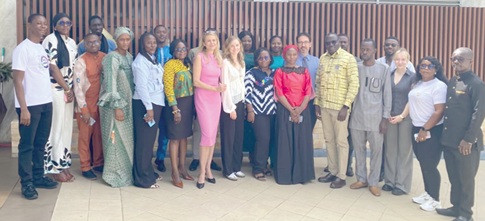
The programme brought together journalism educators and media professionals from 10 countries across the Sahel and West Africa.
Its purpose was to give journalism educators practical skills to help prepare journalists to identify and challenge information manipulation, including threats linked to artificial intelligence (AI).
Funded by the German Federal Foreign Office, the initiative is being delivered in partnership with the Erich-Brost Institute for International Journalism at TU Dortmund University in Germany and the University of Education, Winneba.
Participants took part in expert-led sessions, practical workshops, comparative research presentations and exchanges designed to improve their understanding of disinformation and its impact on society.
A threat to democratic institutions
Mr Lanshaw said information manipulation was a global problem rather than an issue confined to individual countries. He said Germany and other parts of Europe, as well as Ghana and countries in the Sahel, had all been affected.
“The consequences can be profound, weakening institutions and destabilising society from within,” he said.
He said democratic countries needed to respond with effective communication, openness to criticism and a clear commitment to facts and evidence.
The ambassador also warned that social media algorithms could shape public perceptions by selectively displaying information, even when individual items of content were factually accurate.
Role of journalism education
Professor Susanne Fengler, director of the Erich-Brost Institute for International Journalism, said journalism educators were central to improving media literacy and preparing journalists for the increasing spread of false information.
She said the findings and lessons from the programme would be turned into an online learning module. That would allow journalism educators and media practitioners beyond the participating countries to access the material.
The Pro-Vice-Chancellor of the University of Education, Winneba, Prof. Esther Yeboah Danso, said universities had a responsibility to equip future journalists to verify information, recognise manipulated content and understand the ethical consequences of emerging technologies.
She said the university’s participation would support stronger journalism education, research and professional practice, while enabling African institutions to contribute their experience to international discussions about information integrity.
About the Author