
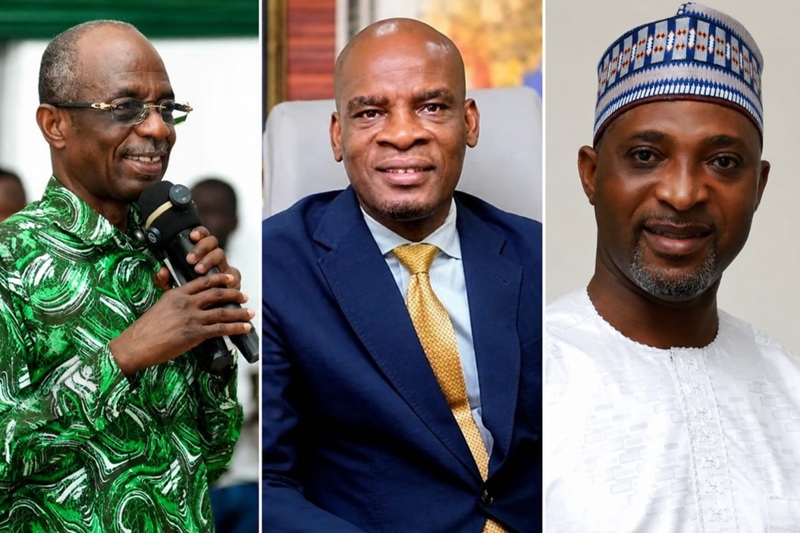
National Chairman of the governing National Democratic Congress, Johnson Asiedu Nketiah, has revealed that the party’s controversial decision to reshuffle its parliamentary leadership ahead of the 2024 general elections played a major role in securing what he described as one of the biggest electoral victories in the Fourth Republic.
Mr Asiedu Nketiah made the remarks during an address in Tamale while reflecting on the internal restructuring exercise that shook the NDC in 2023 and triggered intense political debate across the country.
The comments have revived discussions surrounding the dramatic removal of the then Minority Leader, Haruna Iddrisu, and former Minority Chief Whip, Muntaka Mohammed-Mubarak, from the leadership of the Minority Caucus in Parliament.
The parliamentary reshuffle, announced through a letter to Parliament dated January 23, 2023, saw Cassiel Ato Forson appointed as Minority Leader to replace Haruna Iddrisu.
Under the same changes, Emmanuel Armah-Kofi Buah replaced James Klutse Avedzi as Deputy Minority Leader, while Kwame Governs Agbodza became Minority Whip.
Ahmed Ibrahim and Comfort Doyoe Cudjoe-Ghansah were also named as First and Second Deputy Whips respectively.
At the time, the changes sparked confusion and anger within sections of the NDC, with many supporters questioning the removal of experienced parliamentary leaders barely months before a crucial national election.
However, Mr Asiedu Nketiah now insists the decision was strategic and necessary to reposition the party for electoral victory.
“New things were emerging and I said that we have to change the forward line of Parliament otherwise it will be difficult for us to win the election,” he explained.
According to him, his role as National Chairman required him to make difficult political decisions aimed at strengthening the party’s competitiveness ahead of the elections.
“You have elected me as Chairman of this party, I am the coach of the party going into the election so let me make the changes that will win us the election,” he recounted.
The NDC chairman disclosed that the decision initially generated disagreements within the party, including reservations from President John Dramani Mahama, who was then preparing to lead the party into the 2024 elections.
Despite the tensions, Mr Asiedu Nketiah maintained that the restructuring exercise was never motivated by personal hostility toward Haruna Iddrisu or Muntaka Mohammed-Mubarak.
“There was hell and people started thinking that somebody who has been my friend for more than 20 years has suddenly become my enemy,” he stated.
He stressed that the changes were purely strategic and intended to inject new energy into the party’s parliamentary front as part of a broader restructuring process from the grassroots to the national level.
Political observers at the time described the reshuffle as one of the boldest internal decisions in the history of the NDC, especially given the influence and popularity of Haruna Iddrisu within the party.
The move also fueled speculation about deep internal divisions within the opposition party before the elections, with critics accusing the leadership of sidelining senior figures.
However, following the NDC’s victory in the 2024 elections, President Mahama appointed both Haruna Iddrisu and Muntaka Mohammed-Mubarak to senior government positions in what many analysts viewed as an attempt to restore internal balance and unity within the party
Mr Asiedu Nketiah revealed that after the elections he personally advised President Mahama not to exclude the two experienced politicians from government.
According to him, the President agreed with that recommendation, leading to their eventual appointments.
The NDC chairman argued that the election outcome ultimately vindicated the controversial leadership changes.
“We went into the election, and we won. Have you seen such victory in Ghana since the beginning of the Fourth Republic?” he asked supporters.
He also used the occasion to caution party supporters against internal factionalism and the creation of camps around individual personalities within the NDC.
“If you are forming groups—Haruna groups, Asiedu Nketiah groups—that is not our case. The NDC will continue to be one,” he warned.
Mr Asiedu Nketiah emphasized that disagreements and strategic debates are natural in politics but insisted unity remains essential if the governing party intends to maintain political stability and consolidate its electoral gains.
The latest comments come at a time when internal discussions within the NDC are already intensifying over appointments, grassroots dissatisfaction and the future direction of the party under the Mahama administration.
Political analysts say the chairman’s remarks could reopen old wounds within sections of the party while also reinforcing his growing influence over the NDC’s strategic direction ahead of future elections.
About the Author